
Leopard 45 Buyer’s Review: Specs, Weak Points and Used Prices
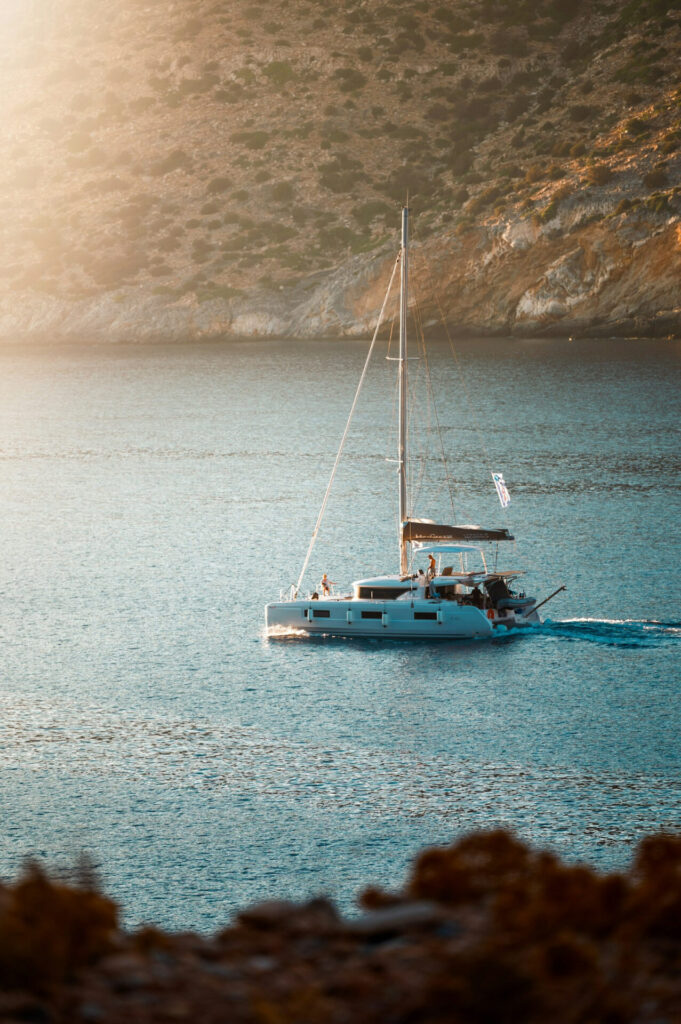
The Leopard 45 is one of the most common mid-40-foot cruising catamarans on the used market. Robertson and Caine built hundreds for private owners and for The Moorings and Sunsail. This review covers the 2017-on boat, the 2020 update and the unrelated Leopard 45 of the late 1990s. It sets out what the magazine testers found, what owners report, the survey points that matter on an ex-charter cat, and what they are listed for now.
Last checked: November 2026. This is a buyer’s review compiled from builder information, named magazine tests and owner reports. We have not sailed the boat ourselves. Specifications vary between sources and model years, and asking prices are not sale prices.
Two boats, one name
Before you compare listings, check the year. There have been two Leopards called the 45, and the newer one also appears in charter fleets as the Moorings 4500 and the Sunsail 454.
The first 45 (late 1990s to early 2000s). CatamaranSite lists it as the “Leopard 45 Classic”, built 1997 to 2001 within a series it dates to 2004. Its page names Simonis Voogd in the text but Morrelli and Melvin in the spec table. A broker listing for a 2000 boat credits A. Simonis. Its figures: 13.72 m long, 7.42 m beam, 1.24 m draft, 27,981 lb. The 2000 boat listed in New Zealand has two 55 hp Yanmar 4JH3E engines, four cabins and four heads.
The current-generation 45 (2017 on). It was designed by Simonis Voogd with Robertson and Caine’s in-house team, to a brief from The Moorings, Sunsail and Leopard. It made its North American debut at the Annapolis sailboat show in autumn 2016 and is usually dated as a 2017 model. It replaced the Leopard 44, which boats.com notes was the last Gino Morrelli design in the range. Charter versions are the Moorings 4500 and the Sunsail 454. Yachting World reported in 2026 that 379 had been built since 2016. Multihulls World says the model stayed in the catalogue for seven years and sold almost twice as many as the 44, with just under half of the fleet in private hands. Leopard’s current sailing range lists the 43, 46 and 52. The new Leopard 46, tested by Yachting World in 2026, is its replacement.
The 2020 update and the lounge option
In 2020 the boat got a redesigned hardtop with a lounge area on top, with seating, sunpads and a low table. It also gained an extra hull window amidships and upgraded joinery. Multihulls World notes that the first boats had no furniture on the bimini, and that the lounge option became popular quickly. Two 2021 boats offered in the Seychelles this autumn are both lounge versions. If you want the upper deck, filter listings for 2020 and later and check the specification sheet. Do not assume a boat has it.
Published specifications
| Item | Figure | Source |
|---|---|---|
| LOA / LWL | 45 ft / 42 ft 11 in | SAIL |
| Beam | 24 ft 2 in (7.36 m) | SAIL, Yachting World |
| Draft | 4 ft 11 in (1.50 m); boats.com gives 5 ft 1 in | SAIL, Yachting World |
| Displacement | 31,967 lb (14,500 kg); Yachting World quotes 14,900 kg | SAIL, boat-specs.com |
| Load capacity | 4,600 kg | boat-specs.com |
| Sail area | 1,288 sq ft (SAIL); 1,328 sq ft (boats.com) | SAIL, boats.com |
| Air draft | 70 ft | SAIL |
| Bridgedeck clearance | 0.83 m (2 ft 9 in) | CatamaranSite |
| Engines | 2 x 45 hp Yanmar | SAIL |
| Fuel / water / holding | 185 / 206 US gal; 170 L holding | SAIL, boat-specs.com |
| Cabins | 3 (owner’s version) or 4, plus optional forepeak crew berth | boats.com, Yachting World |
Construction is balsa-cored glassfibre in the hulls and deck, vacuum-bagged according to CatamaranSite, with solid laminate where hardware is mounted according to Cruising World. SAIL’s SA/D ratio of 20 and D/L of 181 show the priorities: a cruising and charter boat that carries a lot of weight, not a performance cat.
Layout: the forward cockpit is the big idea
Alex Simonis did without the usual bridgedeck bulkheads. In their place is a lattice of glassfibre and stainless steel, which allowed a large clear Lexan front and a watertight door through to a second cockpit on the foredeck. Cruising World’s judges rated the forward lounge the best in its category, and only one boat in the whole test fleet beat its visibility. The saloon is turned round compared with older cats: the galley is forward, the dining table aft by the cockpit, and Yachting World notes that the inside and outside dining areas mirror each other. The mast was moved aft, which Cruising World says balanced the sail plan and made sail handling simpler.
The helm is a raised bulkhead station to starboard with a bench for two. Lines run to two electric winches on the coachroof. In the owner’s version, the starboard hull is one owner’s suite. Port has two cabins with their own heads. The four-cabin charter version has identical hulls. The optional crew berth in the forepeak puts the bunk in the port bow and the toilet in the starboard bow. Boats.com did not think it would be comfortable.
Leopard 45 under sail: what the testers recorded
The data is thin, partly because test days were light. Tom Dove’s SAIL test in Annapolis had no wind at all. Under power the boat made 7.3 knots at 2,400 rpm and turned in about its own length. Mark Pillsbury’s Cruising World sea trial in about 10 knots of breeze gave 6.1 knots close-hauled and 7.7 knots on a reach, with a square-top main, a slightly overlapping genoa and a screecher on a bowsprit. Yachting World said in 2020 that the optional square-top main helps upwind. A Multihulls World caption says the boat comes alive once the breeze builds.
The critical points:
- Weight forward. SAIL questioned putting the forward lounge, water tanks and generator so far forward, and mentioned video that seemed to show the leeward bow ploughing through waves on a moderate reach. The designer disputes the concern. Keep heavy gear such as spare anchors, chain and dive kit out of the forward lockers.
- Visibility to the port bow. Boats.com found a tall skipper had to stand on tiptoe at the starboard helm to see the port bow. That matters when docking.
- Small trampoline. Boats.com noted the trampoline had shrunk and that deck lockers cut into it.
- Interior details. SAIL wanted more handholds in the saloon and found the cushions and seat heights better suited to tall people.
A Cruising World Best Charter Boat award (2017) and a big charter fleet show what the boat does well: easy handling for mixed crews, light and space, and simple systems.
Weak points and survey checklist
Most used boats in this model are either ex-charter or were bought new through an ownership programme. Read our guide to ex-charter versus owner’s version catamarans first. Then make sure the survey covers:
- Saildrives and engines: service records, seal and diaphragm replacement, corrosion around the leg, and engine hours set against the boat’s age. Charter boats run engines a lot.
- Large windows and the forward door: the owners of one new 45, whose video series is indexed by Avit Marine, reseated four large windows to cure leaks. Hose-test the hull and coachroof windows and the forward cockpit door, and look for staining inside.
- Rig: the same series includes episodes on ongoing mast warranty problems. Have a rigger inspect the mast, spreaders, chainplates and fittings. On a charter boat, check the wear on halyards and sheets at the winches.
- Delivery and installation faults: one episode title reports a rusted engine and a destroyed saildrive at handover, and another shows a poorly installed autopilot that Raymarine replaced under warranty. Ask for the warranty file on any boat less than five years old.
- Balsa core: check the deck and coachroof around winches, stanchions, cleats and the davits for moisture. Pay particular attention to anything added after delivery.
- Bridgedeck underside and forward cockpit structure: with 0.83 m clearance listed, look for slamming marks, and check the forward cockpit area for stress cracks given the weight carried there.
- Charter wear: galley, heads, hatches, cushions and davits take the most punishment. Price in refits rather than expecting perfection.
Our survey guide explains how to brief the surveyor and what to ask for in writing.
New and used prices
New, SAIL quoted $555,000 sailaway in 2017 and Cruising World about $580,000 depending on options. Yachting World gave €488,000 ex VAT for the 2020 version.
Used, in November 2026:
- Two 2021 lounge versions in Mahé, Seychelles, one of them leaving the Sunsail fleet, listed via TheYachtMarket at about £414,000 and £417,000 (seen on Boat Hound).
- CatamaranSite showed five boats for sale: four from $350,000 to $849,000, plus one in Fiji at €525,000. It lists a median sold price of $730,000 across 26 recorded sales. That is higher than most current asking prices, so we would treat it with caution.
- The 1990s boat is much cheaper: CatamaranSite records a median sold price of $265,000 across 12 sales and showed a 2000 boat in Guatemala at $275,000.
Each boat’s history, charter or private, and its equipment explain much of the spread. Check whether VAT has been paid on boats in Europe. Our specs page for the model links to any boats listed on catamarket.
Who it suits, and the alternatives
The 45 suits families and couples who live aboard or cruise in the trade winds. Many of them value the forward cockpit, the views from the saloon and the easy sail handling more than upwind speed. It also makes sense for anyone who wants to put a boat into a charter management scheme for a few years. It is a weaker choice if you want a boat that points high, sails well in light air or carries a big payload without slowing down.
Compare it with:
- Leopard 44: the predecessor. Multihulls World says the 45 kept the 44’s brief of a simple, reliable, easy-to-handle cat, so compare condition and price carefully.
- Leopard 46: the replacement, with a taller rig and up to 15 percent more sail area according to Yachting World, at a higher new price.
- Fountaine Pajot Elba 45: the French rival in the same size class.
- Lagoon and Bali models of the same size, if you want a different layout.
Browse the catamaran marketplace for boats currently available.
Related guides
- Fountaine Pajot Antigua 37 vs Belize 43: Used Buyer’s Comparison
- Lagoon Catamarans Model by Model: Which Years to Buy and What to Check
- Bluewater Catamarans: Outremer, Catana, Privilège, HH and Seawind Compared
- HH55 and HH66 Review: Morrelli & Melvin’s Carbon Cats for Buyers
Sources
- SAIL – Boat Review (Tom Dove, 2017)
- Cruising World – Boat review (Mark Pillsbury)
- Cruising World – Best Charter Boat 2017 (Herb McCormick)
- boats.com – New sailing catamaran from Robertson and Caine (Zuzana Prochazka)
- Yachting World – New hard-top design (2020)
- Yachting World – Leopard 46 review: Can the new cat fill the 45’s big shoes? (Toby Hodges, 2026)
- Multihulls World – A catamaran for charter and for private owners
- Boat-specs.com – Robertson and Caine datasheet
- CatamaranSite – 2017-on model page and market data (checked November 2026)
- CatamaranSite – 1990s “Classic” model page and market data (checked November 2026)
- Boat Hound – 2021 Leopard 45 lounge version, Mahé (checked November 2026)
- Boat Hound – 2021 Leopard 45 lounge version ex Sunsail, Mahé (checked November 2026)
- The Multihull Company – 2000 listing, Tauranga (checked November 2026)
- Avit Marine – New yacht brokers and your warranty, part 2 (owner video index)
- Avit Marine – Factory options and owner experience (SV Liger video index)
- Leopard Catamarans – current model range
Cover photo: Apostolis Michailidis on Unsplash.